
Hilton’s Electronic Security installs security systems for school districts, private schools, and campuses across Central Pennsylvania. Schools carry a requirement no other sector has, which is that every decision gets made twice, once for daily practicality and once for the worst day anyone can imagine. A door that locks properly has to also let four hundred students through in six minutes. A lockdown has to work in seconds and be operable by whoever happens to be in the office. Getting both right at once is the whole job here.
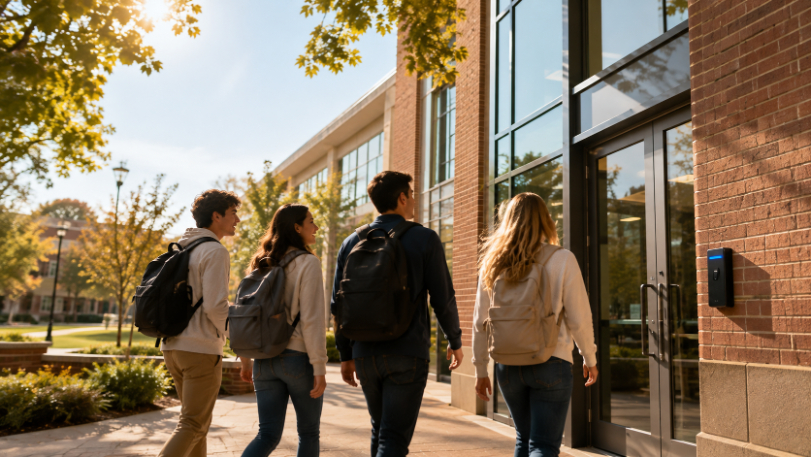
The security measure that fails in schools is the one that makes an ordinary Tuesday harder. A door that is awkward gets propped. A visitor process that takes too long gets skipped when the room is busy. A lockdown that requires someone to find a specific person in a specific office does not get used. Anything we install has to survive contact with a working school day, or it will be worked around within a month.
Our technicians plan around the rhythm of the building, the morning arrival, the deliveries, the parent pickups, the after-hours use of the gym and the auditorium by groups who need some doors and not others. Entry gets funneled to a controlled vestibule with an intercom, so the office sees and speaks to a visitor before the lock releases. Interior doors, exterior doors, and the areas that get used in the evenings all go on schedules that match how the building is actually occupied, and lockdown is set so it can be triggered quickly from more than one place
School projects have constraints that shape every stage of the work. Most of it has to happen over a summer or a break, budgets frequently run through a grant or a bond with its own reporting requirements, and the district will have staff who need training before the first day back. The equipment also has to be operable by an office administrator rather than a technician, because that is who will use it every day for the next ten years.
Most of what a school system does is unremarkable and daily. It keeps the building locked without anyone standing at a door, it gives the office a look at every visitor before they are admitted, and it means a coach running an evening practice can get into the gym without holding a key to the entire building. The emergency capability matters, and it is a small fraction of what the system does across a year.
Contact Info
Have a question or need a quote? Reach out — our team is ready to help protect your business.
Questions from districts and school administrators tend to be about timing, budget, and who operates the system once it is in. These are the ones we answer most often, covering scheduling work around the school calendar, visitor management, lockdown, community and evening use of buildings, phased projects across several sites, and working with existing equipment.
Most of it over summer break, with smaller phases fitted into winter and spring breaks. We plan the schedule against the district calendar before anything is ordered, so nothing critical is half-finished when students return.
A visitor reaches a locked exterior door with a video intercom. The office sees them, speaks to them, and releases the door into a vestibule rather than into the building. From there they check in at the office before a second controlled door lets them further in. The layout varies by building, and we design it around what the entrance allows.
Yes, and it should be. Relying on a single button in a single office assumes someone is standing there. Lockdown can be triggered from multiple points and, where the district wants it, from a credential or a mobile device.
With schedules and limited credentials. A group using the gym on Tuesday evenings gets access to the gym entrance and the corridor to it, during those hours only, with no ability to reach classrooms or offices. When the booking ends, the access ends.
Yes, and most districts do it that way. We usually recommend starting with the main entry and perimeter doors at each building, since that is where the return is highest, then adding interior access and camera coverage as budget allows. Systems are specified so later phases join the existing one rather than replacing it.
Often. We test the existing cameras, panels, and cabling first. Where a platform is current and supported we expand it, and where it was installed piecemeal over many years we will tell you plainly what is worth keeping and what is not.
Tell us how many buildings are involved, what is already installed, and what the budget and timeline look like. We will walk each site, look at the entries and the way the day runs, and put together something that can be phased across breaks rather than delivered all at once.