
Hilton’s Electronic Security installs security systems for restaurants, bars, cafes, and food service operations across Central Pennsylvania. Food service has a security profile unlike anything else we work in. Staff turnover runs high, the back door is open constantly for deliveries and trash, cash still moves through the building, and the most valuable things on site are frequently sitting in a walk-in that anyone in a chef’s jacket can open. The exposure is not dramatic, it is constant and small, and it adds up over a year.
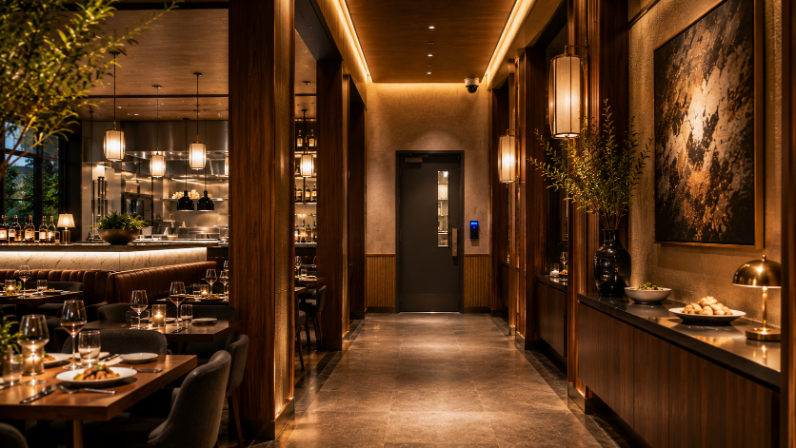
Owners usually think about the dining room first, and the dining room is rarely where the problem is. It is the back door propped open on a hot service, the walk-in that nobody can account for, the office where the safe sits, and the closing shift where one person handles the till and locks up alone at one in the morning. Almost every loss we get called about in this sector traces to one of those four places.
Our technicians walk the site the way a shift runs, from delivery through storage to service to close. Coverage goes on the delivery door, the dry store and walk-in entries, the cash handling area, and the staff exit. Access control goes on the office and the stock rooms, so a credential can be cancelled the day someone stops turning up, which matters far more here than in sectors where staff stay for years. Everything specified for the back of house is chosen for heat, steam, grease, and washdown, because standard commercial equipment does not last long in a kitchen.
Restaurants cannot close for an installation and cannot afford equipment that fails in the first summer, so both constraints shape how we plan the work. The install is staged around service hours, and every device going into a kitchen or a walk-in area is rated for the conditions it will actually sit in. The parts that go into the dining room are chosen to be unobtrusive, because nobody wants a camera housing dominating the room they spent money designing.
The return here is measured in stock that stops disappearing, disputes that get settled quickly, and staff who are willing to work a close. Footage on the delivery door settles a short delivery with a supplier without a week of phone calls. Access records on the walk-in tell you who was in there when a case of product went missing. For an owner running two or three sites, being able to look in on any of them from a phone at nine on a Friday night is often the single most used feature on the system.
Contact Info
Have a question or need a quote? Reach out — our team is ready to help protect your business.
Questions in this sector are almost always about cost, disruption, and equipment surviving a kitchen, because margins are thin and nobody can close for a week. These are the ones we answer most often, covering installation around service, equipment in heat and grease, cameras in staff areas, high turnover and credentials, multi-site viewing, and whether a system suits a small independent as well as a group.
No. We work around service, which usually means mornings before prep or the gap between lunch and dinner, and we stage the job in sections so the kitchen keeps running. Anything genuinely disruptive gets scheduled on a closed day.
Only if they are rated for it. Heat, steam, and airborne grease will destroy a standard camera within a year. Back-of-house units are specified with sealed housings suited to washdown areas, and we position them where the extraction is not blowing directly across the lens.
Kitchens, prep areas, stockrooms, and corridors are all fine, and they are usually the most useful cameras on the system. Break rooms, changing areas, and restrooms are not. Audio recording carries its own requirements in Pennsylvania, so we set systems up for video only unless you have taken advice on it.
That is exactly the situation where it earns its money. A credential is revoked in seconds when somebody leaves, with no locks to change and no worry about who still has a key to the office or the stock room.
Yes. Locations can be brought together so an owner or area manager views every site from one interface, with permissions set so a general manager sees only their own restaurant.
Usually, yes, but the system should be sized accordingly. A handful of well-placed cameras on the delivery door, the storage, and the till, plus access control on the office, covers most of the exposure for a single site without the cost of a full package.
Tell us what you run, how many covers you do, and where things seem to be going missing. We will walk it from the delivery door through to close, look at what is covered and what is not, and quote a system that suits the operation. For multi-site operators we will put together something consistent across every location.