Hilton’s Electronic Security installs security systems for manufacturing plants, warehouses, and distribution operations across Central Pennsylvania. These sites present a problem most commercial buildings do not, which is that they are deliberately porous. Doors stand open because forklifts run through them, drivers and contractors come and go all day, and three shifts means the building is never genuinely closed. Security here cannot mean locking things down, because the operation would stop. It has to mean knowing who is where, and seeing what happens at the points where goods change hands.
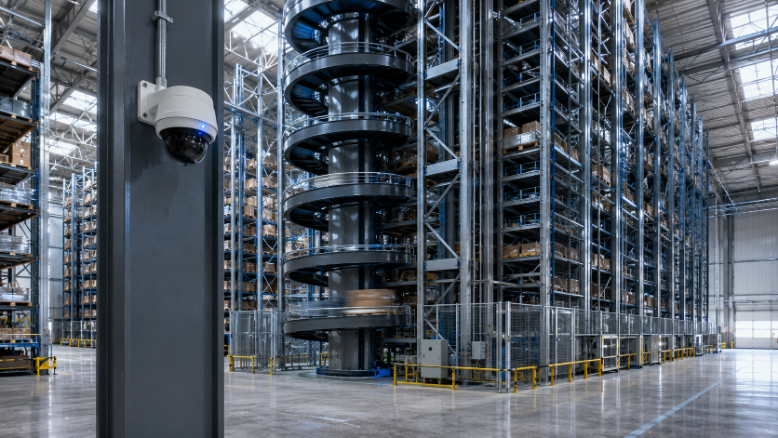
The vulnerable points on a plant or a distribution center are almost always the ones that have to stay working. It is the dock where a trailer sits unattended for forty minutes, the yard gate that props open during a busy shift change, the side door that staff use for the parking lot, and the outbuilding nobody has looked at since it was put up. Losses rarely come through a forced entry, because there is usually no need to force anything.
Our technicians walk the site the way product and people move through it, from the gate to the yard to the dock to the floor to the shipping office. Coverage goes on each of those transitions, and access is set to follow shift patterns rather than fixed office hours, so a second-shift employee has the doors they need at the hours they work and nothing beyond that. Equipment is specified for the environment as well as the task, because a camera that performs in a clean office will not last long in dust, vibration, washdown, or a loading bay in February.
Industrial sites are usually too large to cable conventionally end to end, which is why these projects almost always combine several of our services rather than one. A yard gate needs a wireless link, the office block needs access control, the docks need cameras specified for outdoor light extremes, and all of it needs structured cabling that can cope with the distances and the interference. We plan those pieces as one system rather than four separate jobs, because that is what keeps them working together afterward.
The value on an industrial site is measured against product that goes missing, downtime, and the cost of an incident that ends up in a claim. Coverage on a dock settles a shortage dispute with a carrier in an afternoon rather than turning into weeks of argument between your shipping office and theirs. Access records tell you who was on the floor when a machine was damaged. For operations audited by customers or insurers, the entry log and the footage are frequently what the audit actually asks for.
Contact Info
Have a question or need a quote? Reach out — our team is ready to help protect your business.
Questions from industrial sites are usually about scale and durability, because these projects cover more ground than a typical commercial job and the conditions are harder on equipment. These are the ones we answer most often, covering large-site coverage without trenching, shift-based access, equipment in dusty and cold environments, contractor and driver management, integration with existing systems, and how work gets scheduled around production.
Point-to-point wireless links. Cameras and readers on gates, outbuildings, and remote structures connect back to the main network over a wireless bridge, which usually costs a fraction of trenching and goes in without closing your traffic routes.
Yes, and this is one of the clearer wins on an industrial site. Permissions are set by shift and by area, so a credential works during the hours that person is scheduled and not outside them. Overtime and shift swaps are handled by changing the schedule rather than reissuing anything.
It will if it is specified for it. Enclosure ratings, temperature range, and vibration tolerance all get chosen against the conditions at each position. A camera going on a dusty production floor or an unheated dock is a different unit from the one going in the front office.
Temporary credentials with an expiry date, restricted to the areas and hours they need. When the job ends the credential stops working on its own, which removes the usual problem of contractor cards that stay live for years.
Often. We test the existing cabling, panels, and cameras first. If the platform is current and supported, we expand it. If it was installed piecemeal over fifteen years with no documentation, we will tell you plainly what is worth keeping.
No. We stage the work around your shift schedule and work in zones, with anything that affects a running line moved to planned downtime or a shutdown window. Most of an industrial install happens with the plant operating.
Tell us what the operation is, how many buildings and gates are involved, and where product moves through. We will walk it, look at the docks, the yard, and the access points, and put together a system that covers the site without getting in the way of the work.