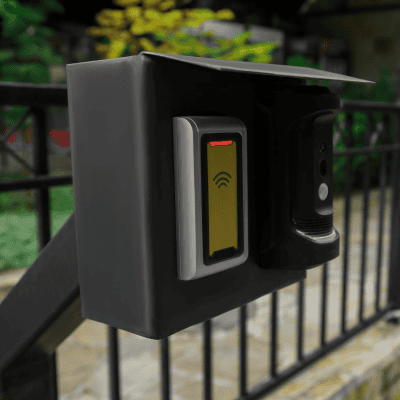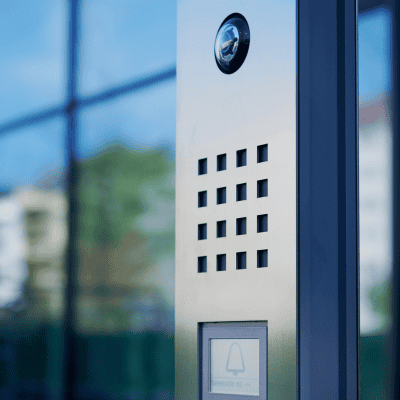
Hilton’s Electronic Security installs intercom systems for buildings across Central Pennsylvania where somebody has to decide whether a person at the door gets to come in. That decision happens at a school entrance, a medical office reception, an apartment lobby, a gated yard, and a warehouse side door, and in every one of those cases the person making it should be able to see and hear who is there first. An intercom is what turns an unlocked door or a guessed decision into a deliberate one.
The value of an intercom is the few seconds it buys. Without one, a member of staff either props the door, walks down to open it and finds out who it is on the way, or buzzes someone in on a voice they half recognize. With one, they see a face and a delivery uniform on the screen, ask a question, and make the call from where they are sitting.
We look at how people arrive at your building before specifying anything, because a busy school entrance in the morning, a lobby with thirty apartments, and a gate a truck pulls up to are three different problems. Station type, camera angle, screen placement, and who the call rings through to are all worked out from that. Where it makes sense, calls can route to a phone as well as a desk station, so a door still gets answered when reception is empty.
The hardware on the wall is the visible part, and it is rarely what decides whether the system is any good. Where the call goes, how quickly it is answered, and how the door releases afterward matter far more day to day. We work all of that out with you and set it up before handover rather than leaving it to be configured later.
Most of the return on an intercom is in doors that stop being propped open and visitors who stop wandering in unannounced. It gives whoever is on the desk a reason to keep the door locked, because opening it is no longer a trip down the corridor.
Contact Info
Have a question or need a quote? Reach out — our team is ready to help protect your business.
Intercom questions usually come up once a building decides to keep its doors locked during the day and has to work out how visitors get in. These are the ones we answer most often, covering audio against video, answering calls on a phone, apartment and multi-tenant setups, gates and long distances, working with existing door hardware, and how an intercom relates to access control.
Video, in almost every case. The point of the system is deciding whether to let someone in, and a voice tells you very little about that. Audio-only stations still make sense for internal room-to-room communication or a second station where the camera adds nothing.
Yes. Calls can ring a desk station, a mobile device, or both, which is what keeps a door answerable when reception is at lunch or the office runs a small team. Ring groups can be set so several people get the call at once.
Yes. Directory stations with a tenant list, calls routed to each unit, and release from inside the apartment are all standard. Tenant changes are handled through the directory rather than by replacing hardware.
Yes. Long runs are handled with the right cable, and where a trench is impractical we can bridge the distance with a point-to-point wireless link instead. That is a common pairing on yards, lots, and rural sites.
Usually. The intercom releases the door through whatever strike or maglock is fitted, and if the current hardware is not suitable for electric release we will say so during the survey and quote the change.
Access control decides whether someone who already has a credential gets through a door. An intercom deals with the people who do not have one, which is most visitors. Buildings that need both usually run them on the same doors, and we install them together.
Tell us which doors visitors arrive at and who is expected to answer them. We will come out, look at the approach, the lighting, and the desk, and quote stations that suit how your building actually runs. If you already have an intercom nobody answers, we will find out why.