

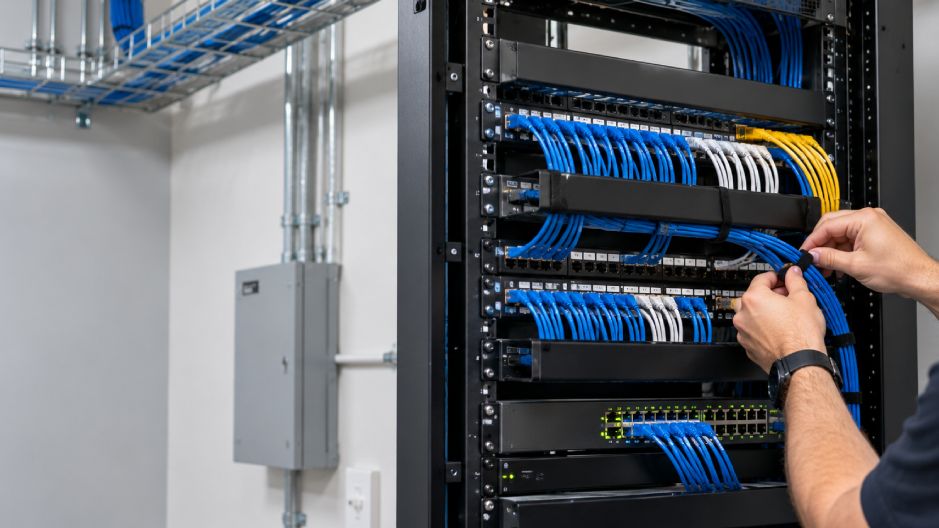
Structured cabling is an organised, standards-based wiring system that carries a building voice, data and video on one network. It uses standard parts so the network is easy to trace, change and grow. Instead of running a fresh cable for each new device, the building has one planned system that everything plugs into. A tidy network installation and cabling job keeps the whole site documented and easy to service. The opposite is point-to-point wiring, where each link is run on its own and nobody can trace it later. Structured cabling trades that tangle for a layout anyone can follow. Over the life of a building, that order saves hours every time something moves or changes.
A planned system starts with a drawing, not a drill. The designer decides where the racks go, how many outlets each room needs, and how the backbone ties them together. Only then does the cable get pulled, tested and labelled. That order is what separates structured cabling from wiring added piece by piece. A building wired this way can take on new tenants or new gear without a rethink. The plan, not the cable, is the valuable part. Why does the layout matter so much? Because a network is only as reliable as the wiring under it.
A structured cabling system has six parts, from the entrance facility to the work area outlet. Each part is a standard building block, and together they form one system.
Splitting the system into named parts is what makes it easy to plan and to service. A fault can be traced to one part, rather than hunted across a tangle of wires. New equipment plugs into the same outlets, so growth does not mean rewiring. The same six parts appear in a small office and a large campus, only at a different scale. Entrance facilities are where the carrier hands off to the building, often in a small room near the street.
The equipment room is the heart, holding switches, servers and the main cross-connect. Backbone cabling, sometimes called vertical cabling, carries traffic between floors. Horizontal cabling is the longest reach, running from a floor closet to every desk. Keeping these parts distinct is what lets one person plan a system another can service.
Structured cabling follows the ANSI/TIA-568 standard in the United States and ISO/IEC 11801 internationally. These standards set the cable grades, the layout and the tests a finished system must pass. ANSI/TIA-568 comes from the Telecommunications Industry Association, and it is the common reference here. Following a standard means a cable from one maker works with gear from another. Certification then checks the finished install against a known mark, not a guess. A certified system is easier to support and to hand over, because its performance is documented.
A cable grade, such as Cat6 or Cat6A, is defined by these same standards. Each grade has a tested limit for speed and distance, so a buyer knows what they are getting. The standards set how tight a bend may be and how far a pair may be untwisted. Small details like those decide whether a run passes its test or fails it. An installer who follows them delivers a system that performs as promised. For a business, that paperwork is what proves the network was built to last.
Structured cabling uses twisted-pair copper such as Cat6 and Cat6A for most runs inside a building. Copper runs well up to about 300 feet; past that, between buildings, or with interference, fiber takes over. Cat6 suits most offices, while Cat6A carries Power over Ethernet better over long runs. Fiber is the choice for distance and for links between buildings, where copper would fade. The right cable depends on the run length, the speed needed and the gear at each end. Shielded cable helps in a noisy setting, such as a plant floor near heavy machines.
Twisted-pair copper is the workhorse, cheap and easy to terminate at a wall outlet. Cat6A adds thicker conductors and better shielding, which helps with heat from Power over Ethernet. Fiber carries light rather than electricity, so distance and interference stop being a worry. A single building often mixes the two, copper to the desks and fiber on the backbone. Choosing well at the survey avoids a costly rerun later. A survey settles the choice, so the cabling matches the network it will carry.
Structured cabling keeps a network tidy, easy to trace and ready to grow, instead of a tangle of point-to-point wires. A tidy system cuts downtime, because a fault is found and fixed quickly. It speeds moves and changes, since a new desk is just a patch in the rack. It supports new equipment, as cameras, phones and access control share the same cabling. A good structured cabling solution is planned once and reused for years.
Labelling and documentation mean the next technician is not left guessing. Downtime is expensive, since a network outage can stop sales, phones and cameras at once. A labelled, documented system turns a long hunt into a quick fix. Growth is cheaper too, because adding a desk is a patch lead, not a new cable run. A tidy rack cools better and lasts longer, which protects the gear it holds. Good cabling is quiet infrastructure: unseen when it works, costly when it does not. Fewer outages and faster fixes add up to real savings for a busy office. That long life is why the up-front plan pays back over time.
Our team plans, installs and certifies network cabling for offices and plants across Central Pennsylvania. A free site survey in Carlisle sets the cable type, runs and rack layout a building needs. In business since 1981, Hilton’s has wrapped up more than 6,000 jobs around Carlisle. One local team runs the cable, tests it and labels it, then supports it afterward. We work in low voltage only, and we document the system so future changes are simple. Because we fit cameras, alarms and access control as well, the cabling is planned for all of them. Testing and labelling are part of every job, not an upsell, so the system is easy to support later. We leave a record of every run, so the next change is simple and quick. That way a future upgrade starts from a map, not a mystery. To get started, ask for a quote and we will arrange the free survey. The Security Advisor can help you scope the work.
A couple of common questions come up around cabling and power.
Yes, PoE sends power and data over the same twisted-pair Ethernet cable, within the IEEE 802.3 power limits. A standard Cat5e or Cat6 cable carries PoE with no special wiring. The switch or injector supplies the power, and the device at the far end draws it. For the detail, see whether a normal Ethernet cable for PoE will do the job.
No, a PoE camera gets power and data over one Ethernet cable, so it needs no separate power run. That single cable is what makes PoE cameras quick to install and tidy to run. It means a camera can go where there is no power socket nearby. See more on whether a separate cable for power is needed.
Category :
Share :